AI Doesn't Compound Until You Rebuild the Operating Model


For three years, the question in every boardroom has been "how do we use AI?"
The question has changed. Most companies haven't noticed.
The new question, the one a small group of operators is actually asking, is "how do we rebuild our operating model around AI so it compounds?" That's a different question. It produces a different kind of company.
Here is the argument I want to make today.
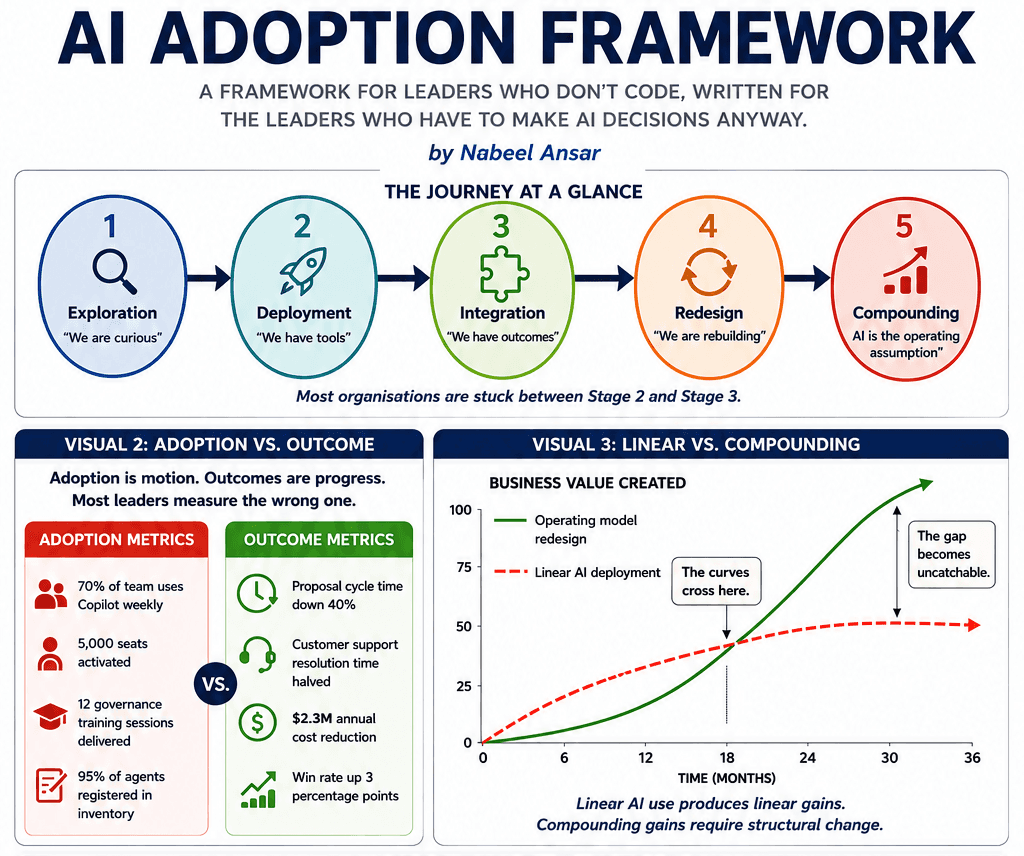
Linear use of AI produces linear gains. Compounding gains require a structural change in how the business is organised. The companies that figure this out in 2026 will be uncatchable by 2028. The ones that don't will spend 2028 wondering why their AI investments stopped producing returns.
What "using AI" actually produces
Linear AI use looks like this. You buy Copilot or Claude. You deploy it. Your team learns to use it. Cycle times improve.
The gains are real. They're also bounded.
Linear AI gain | Why it caps out |
|---|---|
Drafting time cut 60% | Can't cut what's already short |
Email response time halved | Same |
Meeting summaries automated | Same |
Code reviews accelerated | Same |
After 18 months, your team has fully absorbed the tools. Next quarter's productivity numbers look exactly like this quarter's.
Most enterprises are at exactly this point right now. They got the first 20% lift. They're waiting for the next one. It isn't coming, because what they bought was a productivity tool, not an operating model change.
What compounding actually looks like
Compounding AI value is structurally different. The business has to be organised so that every use of AI makes the next use of AI better.
Compounding mechanism | What it produces |
|---|---|
AI interactions generate structured data | Next workflow has better context |
Workflows redesigned around AI capability | New tasks become possible |
Roles built around judgment, not execution | Human capacity scales without proportional hiring |
Data and tooling treated as shared infrastructure | Every team's AI work benefits every other team |
Learning loops built into operations | The organisation gets smarter, not just faster |
The shape is exponential, not linear:
0-6 months: Compounding looks slower than linear deployment
18 months: The curves cross
36 months: The gap becomes uncatchable
Most leaders aren't paying attention to this because the early returns on rebuilding are smaller than the early returns on bolting AI onto existing workflows. Quarterly thinking favours the linear path. Strategic thinking favours the compounding path.
The choice you make this year determines which curve you're on.
Why most companies are stuck on the linear curve
Three structural reasons. None of them are about technology.
Reason | What it does |
|---|---|
Organisations are optimised for the work that exists | AI gets deployed as an accelerant for what already happens, not a foundation for what could happen instead. Linear gains follow. |
Leadership measures velocity, not redesign | "Deployed Copilot across 5,000 seats" is a velocity metric. "Redesigned three workflows around AI as the primary actor" is a redesign metric. Boards reward the first. |
Rebuilding looks unproductive short-term | Redesigning an operating model is slow. Linear AI deployment looks productive immediately. Leaders who choose rebuilding take political risk now for results in 18 months. |
These three forces together explain why so few companies are doing the harder work. The incentive structure rewards the easy path even when the hard path produces better outcomes.
What rebuilding actually means
Five shifts. None of them are optional if you want compounding returns.
The shift | What it looks like in practice |
|---|---|
Talent | Roles redesigned around judgment, not execution. People hired for what AI can't do well. |
Workflow | Rebuilt around AI as the primary actor. Humans inserted at decision points, not as default executor. |
Measurement | Outcomes tracked instead of adoption. "Value created per employee" replaces "tools deployed." |
Decision-making | Authority distributed closer to where AI lives. Bureaucratic escalation breaks the compounding loop. |
Infrastructure | Data and tooling treated as shared assets. Every team's AI work makes every other team's better. |
Notice what this list doesn't include:
New tools
New vendors
Bigger AI budgets
The rebuild is about organisational design, not technology procurement.
Most leaders get this exactly backwards. They believe more AI spend produces more AI value. The actual relationship is that better operating model design produces more AI value, and the spend question becomes secondary.
The honest framing for 2026
I'll be direct.
The companies that win the next three years won't be the ones with the biggest AI budgets. They'll be the ones that rebuilt their operating models early.
The compounding effect is real. It's predictable. It's already showing up in businesses that started this work 18 months ago.
The companies that lose are doing something else. They're deploying AI tools on top of an operating model designed for the work of 2019. They're getting linear gains and assuming next quarter will produce more. It won't. The plateau is structural, not temporary.
The honest question for any leader right now isn't "how much AI should we deploy?" It's:
"What would we redesign if AI were the primary actor in our operations rather than a productivity assistant?"
If you can answer that question crisply, you're on the compounding curve. If the answer is "I don't know, we're still figuring out how to use Copilot," you're on the linear curve.
The linear curve is going to disappoint you within four quarters.
What to do this quarter
Three actions. Do them in order. Don't try to do all five shifts at once.
Action | What it produces |
|---|---|
Pick one core workflow. Redesign from scratch around AI. | A proof point your organisation can rally around |
Rewrite one role description to assume AI as the executor | A signal that the model is changing |
Move one decision authority closer to people working alongside AI | A test of whether your organisation can operate the new model |
These aren't technology projects. They're operating model changes. Each is small enough to ship in 90 days. Each is consequential enough to start the compounding effect.
Companies that try to rebuild everything at once stall within six months. Companies that sequence the rebuild carefully are still going strong in year two.
The bottom line
AI doesn't compound until you rebuild the operating model. Most leaders haven't.
The window for catching up is closing faster than the conversation in most boardrooms assumes.
Two paths:
Linear path: More AI deployments, same operating model. Linear curve, inevitable plateau.
Compounding path: Redesign one thing at a time, sequence carefully, measure compounding. Different curve entirely.
You don't have to choose perfectly. You just have to choose differently from what got you the first 20% lift.
The next 20% comes from somewhere else.