Microsoft 365 E7 Went Live. Here's What It Actually Changes and What It Doesn't


Microsoft launched its biggest enterprise licensing change in a decade this month.
Microsoft 365 E7 went live on May 1st at $99 per user per month. It bundles E5, Copilot, Agent 365, and Entra Suite into a single SKU.
The trade press covered the licensing math. The Microsoft partners covered the procurement angle. Vendor blogs covered the marketing pitch.
Almost nobody is writing about what actually changes inside a business when this gets turned on.
I've been working with E7 components for the last several months. Here's the honest version, written for the operators who'll have to make this decision in the next twelve months.
Three things E7 actually changes. Three things it doesn't. The gap between those two lists is where the marketing falls apart.
What's in the bundle
E7 isn't a single product. It's four things that used to be sold separately:
Component | What it is | Was previously |
|---|---|---|
Microsoft 365 E5 | Productivity, security, compliance | $57/user |
Microsoft 365 Copilot | AI in Word, Excel, PowerPoint, Outlook | $30/user add-on |
Agent 365 | Control plane for AI agents | New, $15/user standalone |
Entra Suite | Identity and access controls | Add-on tier above E5 |
Bundle price: $99 per user. À la carte: about $117. Headline savings: $18 per user.
That's the licensing math. Everyone has covered it. What hasn't been covered is what changes operationally.
What E7 actually changes
Three real shifts. Each one earns its place in the decision.
What changes | Why it matters |
|---|---|
Agents become governable, not just deployable | First time you can see every agent in your environment in one place, regardless of where it was built. Microsoft, third-party, custom, even AWS Bedrock and Google Vertex agents now show up in the Agent 365 registry. |
Agents start being licensed like employees | Each agent gets an Entra ID, access scopes, audit trails, and lifecycle management. It's the first time AI agents fit cleanly into existing identity governance. |
Procurement collapses from four vendors to one | One SKU. One renewal. One contract. One audit scope. Less interesting than the AI story, but for a CIO managing the licensing portfolio, it's the change with the most operational value. |
The control plane is the part most operators underestimate. If you're running multiple agents from multiple sources today, and most enterprises are, you've been governing them ad hoc. Agent 365 puts an end to that. That alone is worth real money to organisations that have already started agent sprawl.
What E7 doesn't change
Now the part the marketing won't tell you.
What doesn't change | Why it matters |
|---|---|
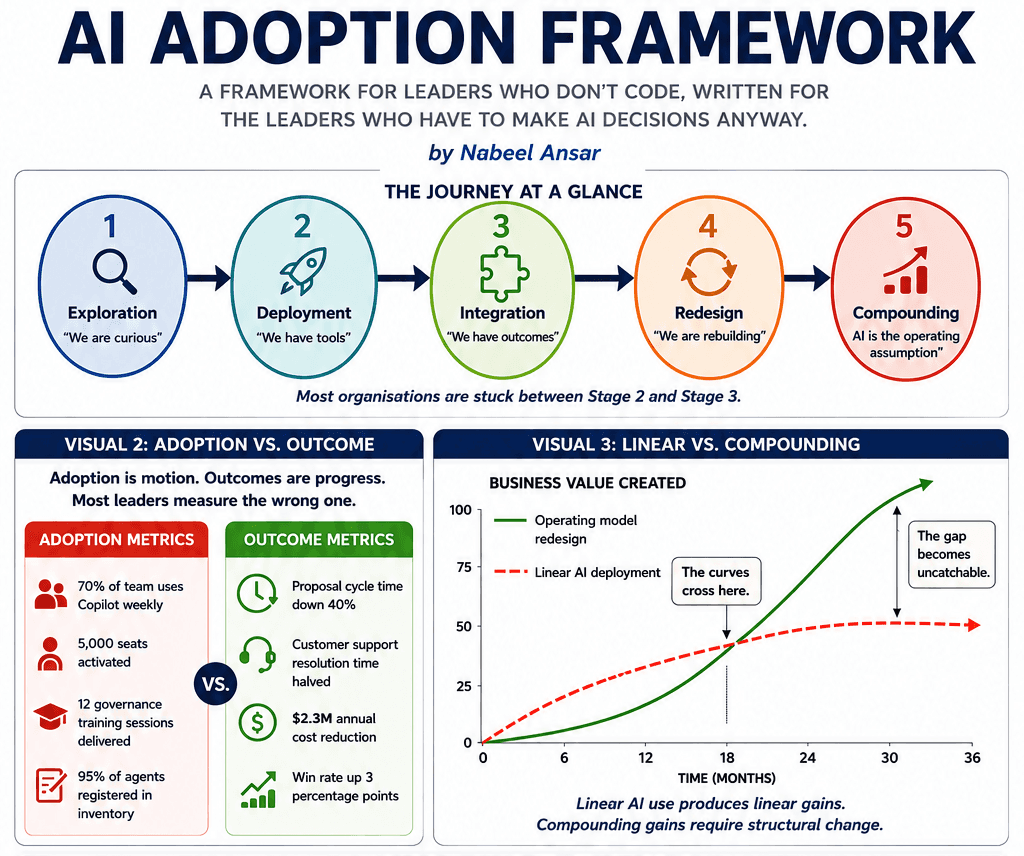
It doesn't make AI valuable on its own | E7 buys you the platform, not the outcome. Most Copilot deployments produced little ROI because nobody redesigned a single workflow. E7 will repeat that pattern unless you do the redesign work. |
It doesn't fix your data foundation | Work IQ amplifies whatever data hygiene you already have. Messy data plus AI equals confidently wrong output. Most enterprises need to fix data hygiene before AI value shows up. |
It doesn't replace strategic thinking | E7 doesn't tell you which workflows matter, which agents to build first, or what success looks like. That's still leadership work. The platform won't compensate for missing strategy. |
The honest pattern is this. Companies that got real value from Copilot already had a clear point of view on what they wanted Copilot to change before they bought it. Companies that bought Copilot to "do AI" got nothing.
E7 reproduces that exact pattern at a higher price point.
Is E7 worth it?
It depends on three questions, in order.
Question | If yes | If no |
|---|---|---|
Are you running agents from multiple sources today? | Agent 365 governance is real value | Standalone Agent 365 at $15/user is enough |
Is your data foundation in reasonable shape? | E7 will accelerate Copilot value | Fix data hygiene first |
Do you have a clear AI strategy with named workflows to redesign? | E7 gives you the platform to execute | The platform won't compensate for missing strategy |
Three yes answers and E7 is worth the bundle premium.
Two out of three and you should be selective. Buy Agent 365 standalone, or stay on E5 + Copilot until the gaps close.
One or zero and E7 will become an expensive stranded asset until something else changes in your organisation.
That last category is where most enterprises sit right now, even if their procurement teams won't admit it.
What this signals about Microsoft's strategy
Beyond the licensing decision, E7 tells you something about where Microsoft is heading.
For the last decade, Microsoft's enterprise pricing has been built around the human user. E3, E5, the various add-ons. The unit was the employee.
E7 is the first SKU built around a different unit. The human user plus the agents working alongside them. That's a quiet but consequential shift. Microsoft is betting that within five years, every enterprise will have more agents than employees, and licensing has to evolve to match.
If they're right, E7 is the first in a long line of Frontier-tier offerings, each redefining how enterprises pay for software in an agent-heavy world.
If they're wrong, E7 ends up remembered as an over-engineered bundle for a market that didn't show up.
My honest read: they're directionally right but probably 18 to 24 months early. Most enterprises don't have the data hygiene, the strategic clarity, or the change-management capacity to use E7 well in 2026. By 2028, more will. The companies preparing now will be ready when the value lands.
The companies waiting until everyone else is doing it will be paying premium prices for capabilities they aren't ready to use.
The bottom line
E7 changes three real things:
Agents become governable
AI gets licensed like employees
Procurement collapses from four vendors to one
E7 doesn't change three other things:
AI doesn't become valuable on its own
Data foundations don't fix themselves
Strategy still has to come from leadership
The marketing will conflate both lists. Don't let it.
The right question for E7 isn't "can we afford it?" It's "are we ready to use it?" Most enterprises will discover the answer is "not yet." That answer is more useful than the bundle math, because it tells you what to fix first.
The companies that get the most out of E7 in 2026 already had their AI strategy in place and were waiting for the right platform to land. The companies who buy E7 hoping it'll create that strategy are about to learn an expensive lesson.
Microsoft has shipped a serious product. Whether it's a serious product for you depends entirely on what you've done before you sign the renewal.