Three Uber Executives, Three AI Stories, One Problem


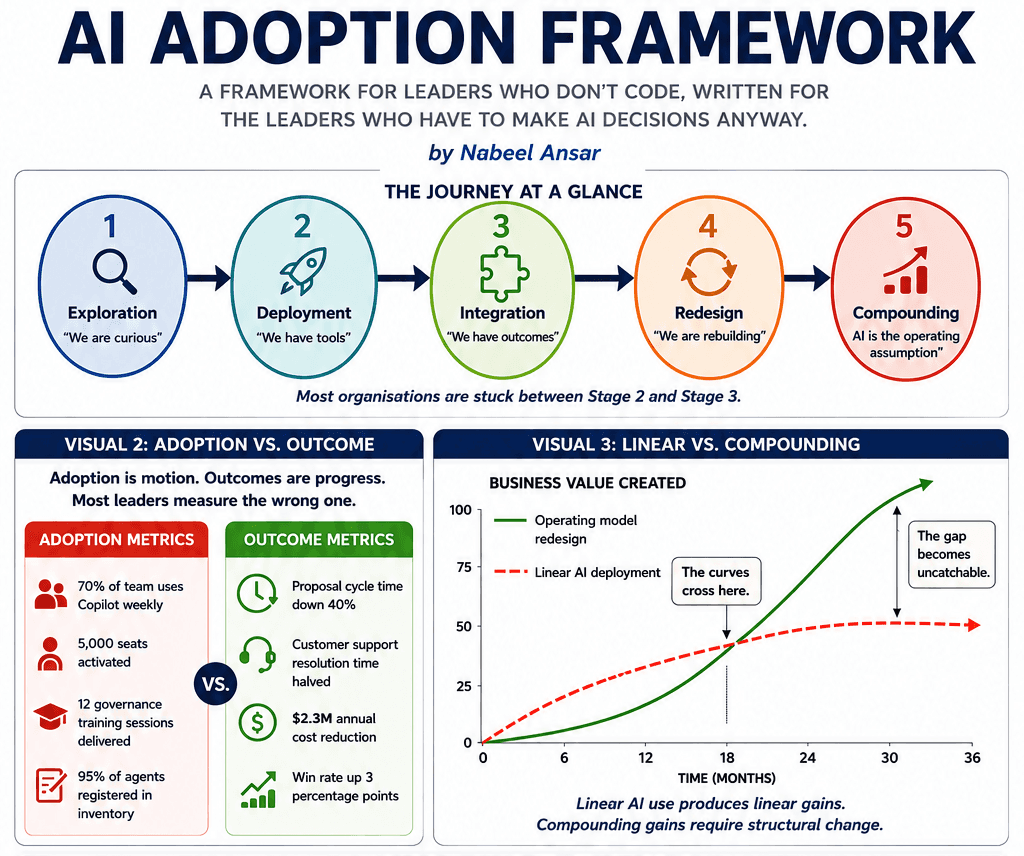
Two weeks ago, I wrote that the era of cheap, loosely tracked, vendor-subsidised AI is ending and that most enterprise leaders are not ready for the budget conversation that's coming.
This week, Uber's three most senior executives publicly confirmed it.
Not in a thoughtful op-ed. Not in a research paper. In their own earnings calls and interviews, contradicting each other in ways that are unusually revealing for a company that normally controls its messaging carefully.
If you are running AI strategy in your organisation, the Uber story this week is the most important data point you'll see this quarter. Let me explain why.
What actually happened
Three Uber executives. Three different messages. One real story.
Executive | What they said | When |
|---|---|---|
CEO Dara Khosrowshahi (Davos) | Most companies are "play-acting" with AI. Real progress requires rebuilding processes around AI, not bolting it on top. | Last month |
CEO Khosrowshahi (earnings call) | Uber is slowing hiring to offset rising AI investment. 10% of committed code is now built by autonomous agents. | Earlier this month |
COO Andrew Macdonald (Rapid Response podcast) | AI consumption is becoming "harder to justify." No clear link between rising token costs and better features for riders and drivers. | This week |
CTO Praveen Neppalli Naga (internal disclosure) | Uber burned through its entire 2026 Claude Code and Cursor budget in four months. | April |
Read those four data points together. The CEO at Davos is telling other companies they're doing AI wrong. The CEO at earnings is slowing hiring to pay for AI. The COO is openly questioning whether the AI spend is worth it. The CTO is reporting that the budget for a single category of AI tools is already exhausted four months into the fiscal year.
That's not a coherent strategic message. That's the sound of an executive team that bought the AI story aggressively, deployed it at scale, and is now publicly working through whether the math actually adds up.
If Uber is having this conversation in public, your competitors are having it in private.
Why this is bigger than Uber
Uber is, by most measures, one of the most aggressive AI adopters in tech. 95% of their engineers use AI tools monthly. 70% of committed code is AI-generated. They have direct relationships with Anthropic, OpenAI, and the major model providers. Their AI spend is sophisticated. Their measurement is sophisticated.
And they cannot demonstrate that the output justifies the bill.
Here is the uncomfortable implication. If Uber is struggling to justify AI ROI with all of those advantages, what does that mean for the average enterprise that has less data, less leverage, less sophistication, and less ability to push back on vendor pricing?
The honest answer is that most enterprises are running an unstated experiment where the cost is real, the productivity gains are real, but the connection between the two is far less direct than the procurement decks claimed.
Uber is the first public crack. It won't be the last.
The three uncomfortable lessons
Three things I think every operator should be taking from this story.
Lesson | What it means for you |
|---|---|
AI budgets are being set against optimistic assumptions | Four months in, Uber's actual usage exceeded the budget by 200% in one tool category. Most enterprises have not built in this kind of variance. |
The link between AI consumption and business outcomes is weaker than it appears | Uber has the best telemetry in the industry and still can't trace token consumption to feature value. Your team probably can't either. |
Slowing hiring is becoming the unstated funding mechanism for AI | Uber explicitly traded headcount growth for AI investment. This is happening at many other companies without being named. The 2026 hiring market is partly an AI funding decision. |
Let me explain each one because the implications are bigger than they look at first glance.
On budget variance. When a sophisticated buyer like Uber blows through a budget category by this much, four months in, it tells you something about how AI budgets are being constructed across the industry. They are being modelled on early-stage usage patterns that don't survive contact with broad deployment. The variance number for your AI program is almost certainly higher than your finance team has modelled. Find out now, not in Q4.
On the consumption-outcome link. The fact that Uber's COO is publicly admitting they can't trace AI consumption to user-visible value is significant. This is the company that helped invent algorithmic operations. If they can't make this link, two things are likely true. The link is genuinely hard to make. And the vendor narrative that "more AI usage equals more value" is detached from reality in ways that have been quietly building for two years.
On the hiring trade-off. Uber said the quiet part out loud. They are slowing hiring to fund AI investment. This is happening at dozens of other companies without being publicly named. Some of them will find that the trade-off is worth it. Many will find that they reduced their human capacity faster than the AI capacity caught up, and that the resulting hole is hard to refill. Knowing which category you're in matters.
How to think about this
If you are responsible for AI budget or AI strategy in your organisation, three principles to take seriously after this week.
One: assume your AI variance is higher than your finance team modelled. If Uber, with all its measurement capability, blew through a budget category by this much, the chance that your own model is more accurate than theirs is low. Build a real variance buffer. 50% above current projection is a defensible starting point.
Two: insist on a defensible link between AI spend and business outcomes before approving the next increase. Not "productivity is up." Not "adoption is up." Actual business outcomes. Revenue. Margin. Cost reduction. Customer satisfaction. If your team cannot produce that link for the AI spend they want next quarter, the answer should be no, regardless of what the vendor pitch says.
Three: understand what you're actually trading off. If you're funding AI by slowing hiring, by reducing other discretionary spend, or by cutting other budget lines, name the trade-off explicitly. The companies that survive this stage will be the ones that made trade-offs consciously. The ones that struggle will be the ones that funded AI by accident, accumulated cost they couldn't trace, and discovered the trade-off after the fact.
The bottom line
Two weeks ago I wrote that AI costs were about to land on enterprise budgets in ways most leaders weren't ready for. This week, one of the most sophisticated AI buyers in the world publicly admitted that the math is harder than the pitch deck promised.
Uber is not the cautionary tale. Uber is the early-disclosure case. They have the data, the discipline, and the public visibility to admit something that most enterprises are quietly experiencing in private. The fact that they're naming it now is a service to every other company that hasn't yet had the same conversation internally.
The companies that learn from Uber's disclosure will save themselves twelve months of expensive learning. The ones that dismiss it as "Uber's problem" will discover the same thing on a longer timeline, with less data to defend their decisions in the boardroom.
You don't have to be Uber to learn this lesson. You just have to be willing to look at the same numbers, ask the same questions, and have the same uncomfortable conversation before your CFO does.
This is the first public crack in the AI ROI story. Treat it as the leading indicator it is.