AI Adoption Framework

A framework for leaders who don't code, written for the leaders who have to make AI decisions anyway.
Why this exists
Most AI strategy content is written for technical leaders, by technical leaders. That's a problem, because most AI decisions are not technical decisions.
This Canvas is for you if you are:
A CEO, CFO, COO, or senior leader without a technical background
Responsible for AI decisions you do not fully understand technically
Trying to translate AI capability into specific business value
Looking for a map to know where you are and what comes next
What you will get from this page:
A clear view of where your organisation sits on the AI adoption journey
The critical decision at your current stage
The most common trap at your current stage
A practical signal that confirms which stage you are actually in
The journey at a glance
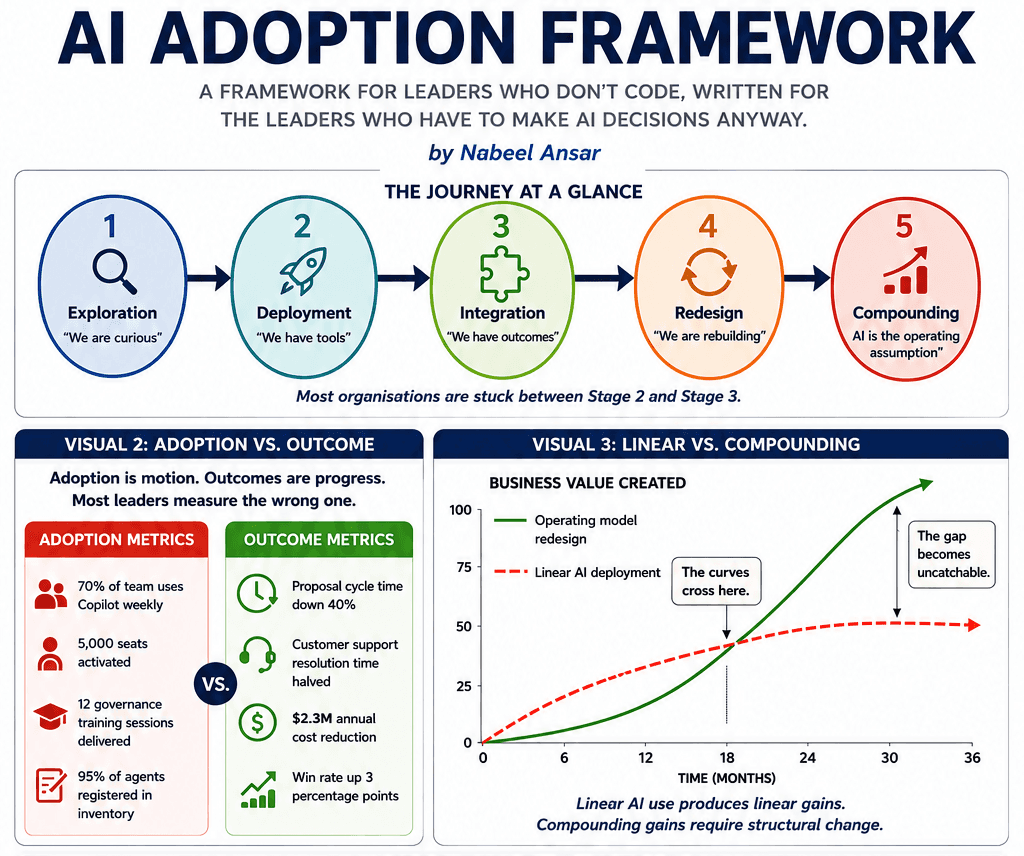
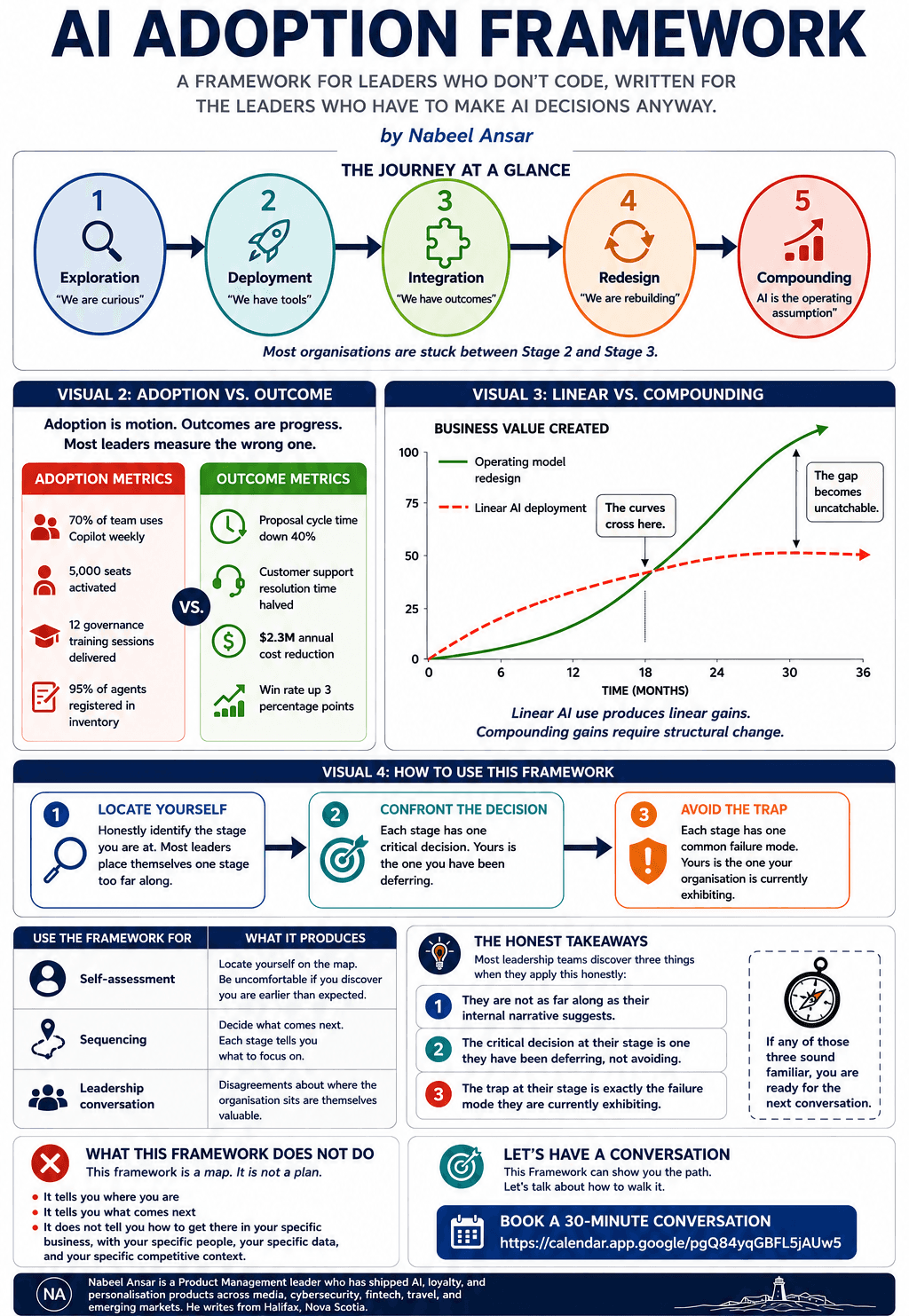
There are five stages. Most organisations are stuck between Stage 2 and Stage 3.
Stage | One-line summary |
|---|---|
Stage 1: Exploration | "We are curious" |
Stage 2: Deployment | "We have tools" |
Stage 3: Integration | "We have outcomes" |
Stage 4: Redesign | "We are rebuilding" |
Stage 5: Compounding | "AI is the operating assumption" |
The Framework: five stages, five decisions, five traps
Stage | What it looks like | The critical decision | The common trap |
|---|---|---|---|
1. Exploration | Curious leadership. A few pilots. No strategy. | Which workflows are worth the first real investment? | Spreading thin across too many pilots |
2. Deployment | Tools bought. Teams using them. Modest productivity gains. | How do we measure value beyond adoption? | Confusing "tools deployed" with "value created" |
3. Integration | AI embedded in specific workflows. Real ROI visible. | How do we govern this without slowing it down? | Theatre governance that does not catch risk |
4. Redesign | Workflows being rebuilt around AI. Roles changing. | What do we restructure first? | Trying to redesign everything at once |
5. Compounding | AI is the operating assumption. New possibilities emerge. | How do we keep accelerating without burning out the team? | Productivity gains erode meaning faster than the org can adapt |
Stage 1: Exploration
What it looks like:
Leadership has heard about AI in board conversations
A few pilots are running, often informally
No coherent strategy, no budget line, no governance framework
AI is a personal interest of one or two leaders, not yet an organisational priority
Who fits here:
Companies in the first 6-12 months of taking AI seriously
Mid-market businesses that have not committed budget
Founder-led organisations where AI is curiosity, not commitment
The critical decision: Which workflows are worth the first real investment?
Not which tools. Not which vendors. Which workflows. The decision is about where AI gets applied first, because the first deployment teaches you everything you need to know to make the second one work.
The common trap: Spreading thin.
Running fifteen small pilots produces fifteen disconnected learnings
None of them add up to organisational capability
Teams that win run one or two real pilots with real measurement attached
The honest signal you are here: You cannot answer "what is our AI strategy?" with anything more specific than "we are exploring AI."
Stage 2: Deployment
What it looks like:
Copilot is licensed across the organisation
Maybe Claude or other tools too
Specific teams use AI daily
Productivity is measurably up
The conversation has shifted from "should we?" to "how do we do this better?"
Who fits here:
Most knowledge-economy businesses with 200+ employees in 2026
Companies past the first wave of deployment
Leadership teams planning the second wave
The critical decision: How do we measure value beyond adoption?
Adoption metrics measure motion. Outcome metrics measure progress. Most leaders measure the wrong one.
Adoption metrics (avoid) | Outcome metrics (track) |
|---|---|
70% of team uses Copilot weekly | Proposal cycle time down 40% |
5,000 seats activated | Customer support resolution time halved |
12 governance training sessions delivered | $2.3M annual cost reduction |
95% of agents registered in inventory | Win rate up 3 percentage points |
The common trap: Adoption theatre.
Leadership celebrates "we deployed AI to 5,000 seats" without anyone asking what happened to the work those 5,000 people produce
Six months later, productivity numbers plateau
The "transformation" is invisible on the P&L
The honest signal you are here: You can name the tools you have deployed. You cannot name the business outcomes those tools have produced.
Stage 3: Integration
What it looks like:
AI is no longer a tool layer sitting on top of the business
It is embedded in specific workflows
Sales proposals are AI-drafted and human-refined
Customer support is AI-triaged and human-resolved
Specific cycle times are measurably down
The CFO is paying attention
Who fits here:
Companies 18+ months into serious AI work
Organisations that have invested in workflow redesign for at least one critical process
Teams seeing real ROI on specific use cases
The critical decision: How do we govern this without slowing it down?
Governance done well must operate at the speed of AI deployment. Done badly, it either bottlenecks the work or rubber-stamps the work.
The principles that separate real governance from theatre:
Tiered review: lightweight for low-risk agents, deep for high-risk
Named accountable owners, not committees
Measure outcomes, not activity
Insert governance into procurement, not parallel to it
The common trap: Theatre governance.
Policies are written
Committees are formed
Quarterly reports are produced
Nothing actually gets stopped, reversed, or denied
The framework looks good and does not catch anything
The honest signal you are here: You can name at least two workflows where AI is producing measurable value. You also have at least one nagging concern about an AI deployment you do not fully control.
Stage 4: Redesign
What it looks like:
The conversation has shifted from "how do we use AI?" to "what would this work look like if AI were the primary actor?"
Roles are being rewritten
Reporting structures are being questioned
New job descriptions emphasise judgment over execution
Some teams are smaller than 18 months ago
Some teams are doing work that did not exist 18 months ago
Who fits here:
A small minority of organisations
The leading edge of enterprise AI adoption
The companies you read about in case studies, not the ones writing them
The critical decision: What do we restructure first?
Linear AI use produces linear gains. Compounding gains require structural change.
Approach | What happens at month 12 | What happens at month 18 | What happens at month 36 |
|---|---|---|---|
Linear deployment | Steady productivity gains | Gains start flattening | Plateau. Growth has stalled. |
Operating model redesign | Slower start, less visible | The curves cross | Dramatically ahead. Still rising. |
The companies that figure this out in 2026 will be uncatchable by 2028.
Operating model redesign is sequential:
Try to do everything at once and you stall
Try to do nothing and you stay in Stage 3 indefinitely
The right approach: pick one core workflow, redesign it from scratch, use the proof point to fund the next
The common trap: All-at-once redesign.
Leadership commits to a comprehensive transformation programme
18 months later, the programme has produced PowerPoint decks and consulting fees
It has not produced operational change
The honest signal you are here: You have at least one job description rewritten because of AI, and at least one decision authority that has moved closer to where AI is being used.
Stage 5: Compounding
What it looks like:
AI is not a tool, a strategy, or an initiative
It is an operating assumption
The business is organised so every use of AI makes the next use of AI better
New capabilities emerge that were not on the original roadmap
The team is doing work that was unimaginable three years ago
Who fits here:
Almost nobody, yet
Maybe a handful of frontier technology companies
The companies who reach this stage in the next 24 months will be uncatchable by 2028
The critical decision: How do we keep accelerating without burning out the team?
Compounding gains create their own pressures:
Teams that produce more with less also feel more, judge more, and decide more
The cognitive load is different but not lower
The companies that sustain Stage 5 protect human capacity as carefully as they protect AI capacity
The common trap: Productivity gains that erode meaning faster than the organisation can adapt.
Cycle times drop
Output rises
Adoption is high
The best people quietly leave because the work no longer feels like theirs
The honest signal you are here: You can name a new capability your organisation has now that did not exist three years ago, and that capability does not depend on any specific AI tool.
How to use this Canvas
Three steps. Do them in order.
Step 1: Locate yourself.
Read each stage carefully
Identify the stage that most accurately describes your organisation today
Most leaders place themselves one stage too far along
Step 2: Confront the critical decision.
Each stage has one critical decision
Yours is the one you have been deferring, not avoiding
Bring it to your next leadership conversation
Step 3: Avoid the trap.
Each stage has one common failure mode
Yours is the one your organisation is currently exhibiting
Naming it is the first move toward addressing it
Use the Canvas for | What it produces |
|---|---|
Self-assessment | Locate yourself on the map. Be uncomfortable if you discover you are earlier than expected. |
Sequencing | Decide what comes next. Each stage tells you what to focus on. |
Leadership conversation | Disagreements about where the organisation sits are themselves valuable. |
Most leadership teams I work with discover three things when they apply this honestly:
They are not as far along as their internal narrative suggests
The critical decision at their stage is one they have been deferring, not avoiding
The trap at their stage is exactly the failure mode they are currently exhibiting
If any of those three sound familiar, you are ready for the next conversation.
What this Canvas does not do
This framework is a map. It is not a plan.
It tells you where you are
It tells you what comes next
It does not tell you how to get there in your specific business, with your specific people, your specific data, and your specific competitive context
That is the work I do with clients. If the Canvas resonates and you want help moving from one stage to the next, the conversation starts with a 30-minute call.