IBM Just Told Enterprises to Stop Deploying More AI. Then They Sold Them More AI


At IBM's Think 2026 conference earlier this month, CEO Arvind Krishna said something that should have been the headline of every enterprise AI publication.
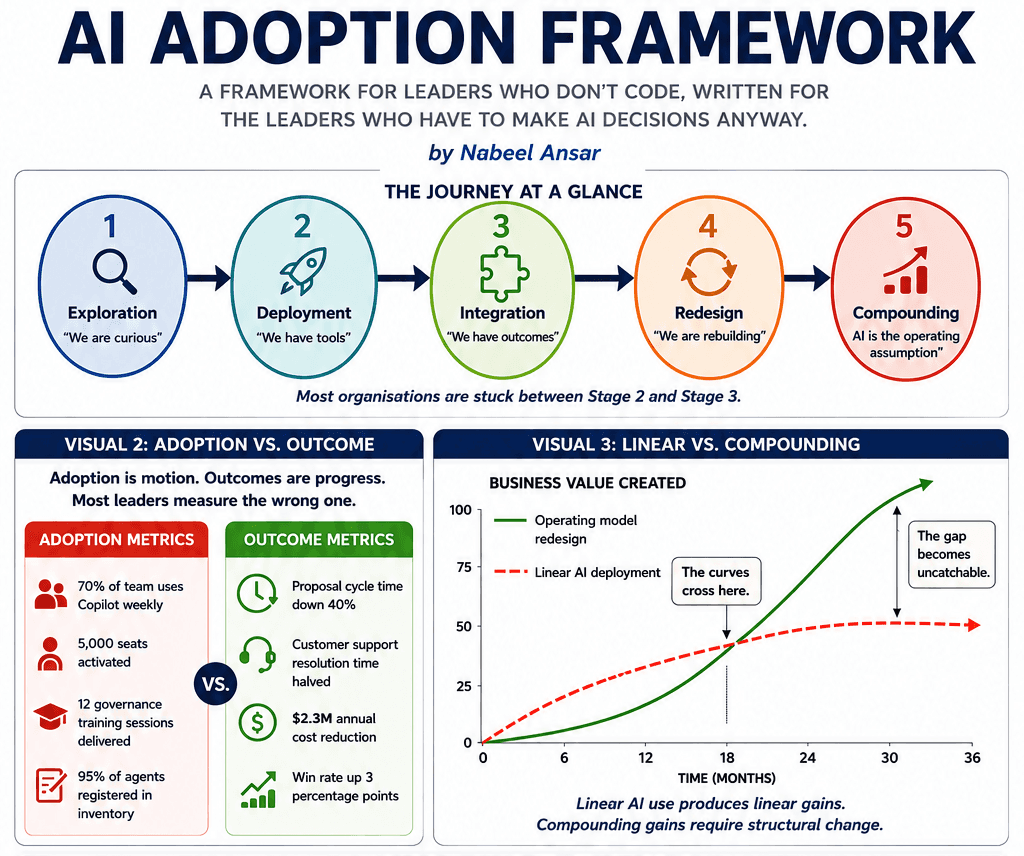
"The enterprises pulling ahead are not deploying more AI. They are redesigning how their business operates."
It was the smartest sentence from any major vendor in the last six months. It is also, almost immediately, the most contradicted sentence from any major vendor in the last six months.
Because in the same keynote, IBM proceeded to announce their most comprehensive expansion of enterprise AI products ever. Watsonx Orchestrate for multi-agent orchestration. IBM Concert for intelligent operations. IBM Sovereign Core for operational independence. IBM Confluent to bring real-time data to AI. A full new lineup of tools designed to help enterprises do exactly what Krishna just told the audience does not work.
This is the moment to pay close attention. The redesign-operations argument has officially moved from edge thinking to mainstream vendor language. The execution gap between what vendors are saying and what they are selling is now visible in real time.
If you can see that gap clearly, you can save your organisation a lot of money. If you cannot, you are about to pay for the contradiction.
What Krishna actually said, stripped of marketing
The Think 2026 framing was unusually clear. Let me extract the argument from the pitch.
What Krishna said | What it means in plain language |
|---|---|
"Enterprises pulling ahead are not deploying more AI" | More AI tools does not equal more AI value |
"They are redesigning how their business operates" | The work is organisational, not technological |
"Many have invested heavily in AI, but only few believe it is paying off" | Most current AI deployments are underperforming on ROI |
This is the same argument I made two weeks ago in this newsletter. It is also the same argument McKinsey, BCG, Deloitte, and a growing list of enterprise consultancies have been making for months. The argument has won. The question now is what comes after.
Krishna's answer in the next breath was to sell more tools. That is where this gets interesting.
The contradiction sitting in plain sight
IBM's products are not bad. Watsonx Orchestrate is a serious platform. IBM Concert solves real problems. The team that built these is doing genuine work.
The contradiction is not in the products. It is in the marketing logic that sits on top of them.
What IBM said on stage | What IBM is selling |
|---|---|
Redesign your operations | Deploy our new orchestration platform |
Stop deploying more AI | Adopt our expanded AI product lineup |
Pulling ahead means restructuring | Pulling ahead means buying watsonx Orchestrate |
Few believe AI is paying off | We have new AI to sell you |
Read those rows again. The contradiction is not subtle. It is not accidental either. IBM is doing what every major vendor in 2026 is now doing: borrowing the language of the operating-model argument to sell exactly the kind of incremental tool deployment that the argument says does not work.
This is the new pattern. Every major AI vendor is converging on the same playbook. Acknowledge the redesign argument in the keynote. Then sell tools as if the redesign argument did not exist. The keynote is for headlines. The tools are for the procurement order.
Why this is happening now
Three forces are pushing the entire vendor ecosystem toward this contradiction.
Force | What it does |
|---|---|
The "AI productivity gains" story is plateauing | Customers are no longer convinced that more AI deployment produces more value. Vendors need a new narrative. |
Operating model redesign is unsellable as a product | You cannot ship a SKU called "redesigned operating model." So vendors borrow the language but ship orchestration platforms. |
Multi-agent orchestration is the new monetisation layer | If the model layer is commoditising and the productivity story is fading, orchestration is where margin lives. The pitch follows the margin. |
The result is that every keynote in the next 12 months is going to sound like IBM's Think 2026 keynote. The redesign argument will be used as the framing. The product pitch will be for the orchestration layer that follows.
This is not because vendors are dishonest. It is because the operating-model argument is structurally hard to monetise, and the orchestration argument is structurally easy to monetise. The market follows the easier path. The pitch follows the market.
What the redesign argument actually requires
Here is what the operating-model redesign actually looks like, stripped of vendor language.
Required change | What it looks like in practice |
|---|---|
Workflows rebuilt around AI as the primary actor | Humans become decision authorities, not default executors |
Roles defined by judgment, not execution | Job descriptions emphasise taste, orchestration, oversight |
Measurement shifts from adoption to outcomes | "Value created per employee" replaces "tools deployed" |
Decision authority distributed closer to where AI lives | Bureaucratic escalation breaks the compounding loop |
Data and tooling treated as shared infrastructure | Every team's AI work benefits every other team's AI work |
Notice what is not on this list. New orchestration platforms. New AI products. New vendors.
The redesign is about organisational architecture. The tools are downstream of the redesign, not upstream of it. A company that buys watsonx Orchestrate without doing the redesign work will have a more powerful platform sitting on top of the same dysfunctional structure. The result will look exactly like the failed Copilot deployments of 2024 and 2025, just at higher token cost.
How to read every AI vendor keynote going forward
This is the practical takeaway. Every major vendor presentation in 2026 and 2027 is going to follow the IBM template. The redesign argument is now the standard opening. The product pitch is what follows.
Three questions to apply to every vendor pitch from this point forward.
Question | Why it matters |
|---|---|
Does the pitch require us to redesign anything before deployment? | If no, the pitch is selling tools dressed up in redesign language |
Will the vendor commit to outcomes that depend on the redesign actually happening? | If no, the redesign is rhetorical, not structural |
Can we get the claimed benefits without buying anything new? | If yes, you might not need the product |
These questions are uncomfortable to ask in a procurement conversation. They are also the questions that separate companies that get real value from AI from companies that fund the vendor ecosystem and wonder why their P&L does not change.
The honest read
I want to be precise about what I think.
IBM is right. The redesign argument has won. The era of deploying AI as a productivity tool layered on top of existing operations is producing diminishing returns. The companies that figure this out early will be uncatchable by 2028.
IBM is also wrong about what comes next. The redesign work is not a procurement decision. It is an organisational architecture decision. Buying more orchestration platforms is not the path through this transition. It is the path that delays the transition while feeling like progress.
The smartest move for any enterprise leader watching the IBM keynote, the SAP-Microsoft keynote, the AWS re:Invent keynote, or the Google Cloud Next keynote in the coming year is to listen carefully to the framing and then ignore the products.
The framing is now correct. The products are still last cycle's answer to last cycle's question.
The bottom line
The redesign-operations argument has officially gone mainstream. That is good news. Enterprise leaders who have been quietly making this case for months now have vendor support to point to in their boardrooms.
But the vendors who are now using this language are also the vendors selling the products that the argument says do not produce value. That contradiction will not resolve itself. It will resolve when buyers either learn to see it clearly or accept the consequences of paying for it.
Listen to the framing. Ignore the products. Do the redesign work. Buy the tools that genuinely accelerate the redesign, not the tools that pretend the redesign is already done.
The companies that get this right in 2026 will be the ones building advantage that compounds. The companies that buy more orchestration platforms will be reading about their successful competitors in 2028.