Are You Doing AI, Or Are You Just Doing AI? Seven Signs Your Program Is Theatre


Are You Doing AI, Or Are You Just Doing AI? Seven Signs Your Program Is Theatre
Most enterprise AI programs in 2026 are not solving business problems.
They are solving the problem of how to look like you are solving business problems with AI.
I want to be direct about this because the question is uncomfortable and the senior leaders who need to ask it are mostly avoiding it. Walk into any boardroom in North America right now and you will find an AI initiative. Walk into the same boardroom and ask what specific business outcome it is producing, and you will get an answer about tool adoption, employee productivity, or "transformation."
Those are not business outcomes. Those are activity reports dressed up as strategy.
If you are starting to suspect that your own AI program might be theatre, this article is for you. Seven specific signals. Direct answers. No comfort.
Why I am writing this now
The AI vendor cycle has reached a specific point. The first wave of enterprise AI deployments is 18 to 24 months old. The hyperscalers just committed $725 billion in 2026 capex. Uber publicly admitted it cannot justify its AI spend. NVIDIA's CEO is on podcasts defending the deployment cycle.
These are not isolated events. They are the same signal. The era of "deploy AI and ROI will follow" is ending. The senior leaders who are honest about whether their AI program is producing real value will spend the next two years building competitive advantage. The ones who are not will spend the next two years explaining variance to their boards.
This article is the diagnostic that tells you which one you are.
Seven signs your AI program is theatre
Read each row honestly. If you find yourself in three or more, your AI program is theatre. Most enterprises will find themselves in five or six.
Signal 1: Your AI strategy is a list of tools deployed
Theatre: "We have rolled out Microsoft Copilot to 5,000 seats, Claude to the engineering team, and a Lovable pilot in marketing."
Real: "We have identified three specific workflows where AI can reduce cycle time by 50% or more, and we are sequencing the work over 18 months."
A list of tools is not a strategy. A list of outcomes is.
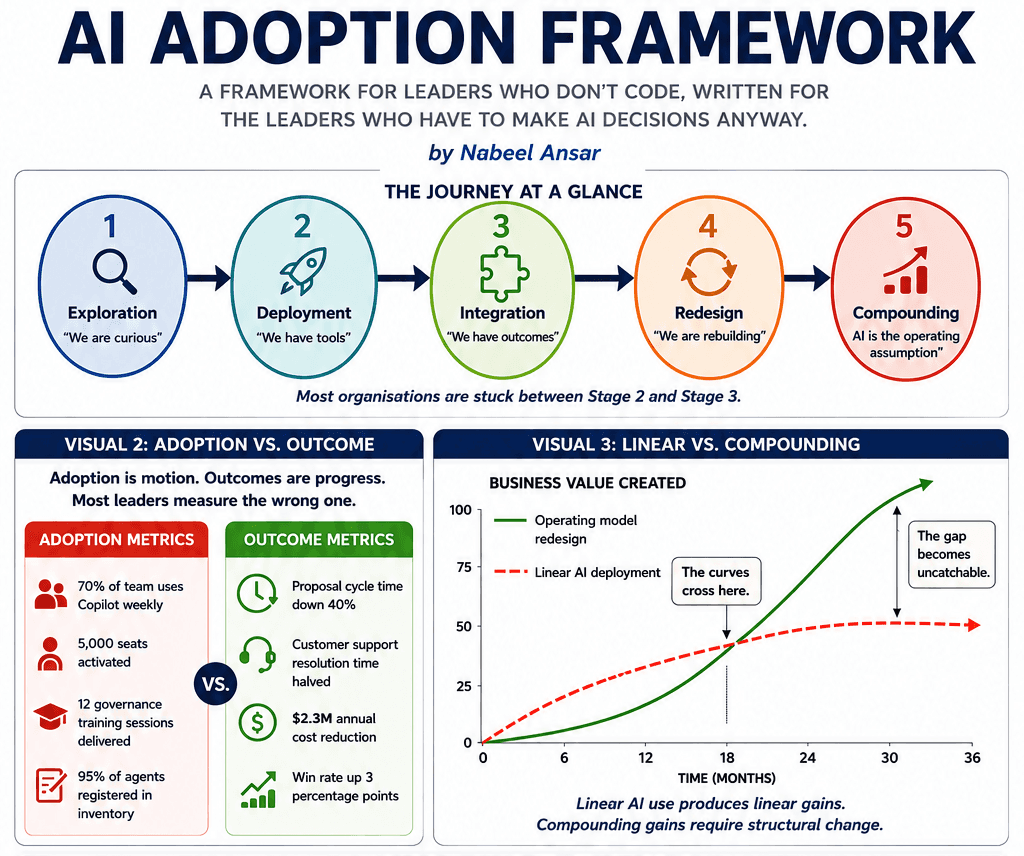
Signal 2: Your AI success metrics measure adoption, not outcomes
Theatre: "70% of our team uses Copilot weekly. AI ethics training completion is 95%. We have registered every AI system in our inventory."
Real: "Our proposal cycle time is down 40%. Our customer support resolution time is halved. We generated $2.3M in measurable cost reduction last year."
Adoption is motion. Outcomes are progress. Most leaders are reporting the first and assuming the second.
Signal 3: Your AI program is led by someone who cannot describe a specific workflow it has changed
Theatre: "Our Chief AI Officer is driving transformation across the organisation."
Real: "Our Chief AI Officer can name three workflows that have been measurably changed, with specific dollar figures attached."
If your AI leader cannot answer "what has changed in the last six months because of your work?" with specifics, the AI program is producing reports, not results.
Signal 4: Your AI roadmap is organised by vendor capability, not by business problem
Theatre: "In Q2 we deploy Copilot Studio agents. In Q3 we evaluate Agent 365. In Q4 we pilot multi-agent orchestration."
Real: "In Q2 we redesign the claims workflow. In Q3 we tackle proposal automation. In Q4 we restructure customer onboarding."
When your roadmap reads like a vendor catalogue, you are letting vendors tell you what to do. That is the opposite of strategy.
Signal 5: Your AI announcements happen at the same cadence as your competitors
Theatre: A competitor announces a Copilot rollout. Three weeks later, you announce yours. Their CEO talks about "AI-first transformation." Three weeks later, your CEO does the same.
Real: Your AI work happens at the cadence your business actually needs. Your announcements describe outcomes that have already happened, not initiatives that have just started.
If your AI communications are reactive to industry noise, the work is reactive too.
Signal 6: Your AI investment grows without anyone asking what the cycle-time reduction has been
Theatre: "Our 2026 AI budget is up 40% from 2025. We are investing aggressively in capability."
Real: "Our 2026 AI budget is up 40% from 2025. Here are the specific cycle-time improvements that justify the increase."
A budget that grows without an outcome conversation attached is a budget that is about to be cut. Your CFO is paying attention to this whether you are or not.
Signal 7: You can name your AI tools but not your AI thesis
Theatre: "We use Copilot, Claude, ChatGPT Enterprise, and we have a custom agent built on AWS Bedrock."
Real: "We believe AI will allow us to grow revenue 20% without growing headcount over the next 24 months. Here is how we are sequencing the work to make that true."
If you cannot describe in one sentence what AI is supposed to do for your business in the next 18 months, you do not have an AI strategy. You have an AI procurement plan.
The honest scoring
How many of the seven did you recognise?
Signals present | What it means |
|---|---|
0-1 | Rare. You are running a real AI program. |
2-3 | Mixed. Mostly real with some performative elements. Common in mature organisations. |
4-5 | Mostly theatre with real elements. Common in mid-market. The framework looks good and produces limited real outcomes. |
6-7 | Pure theatre. Significant risk of budget cuts and reputational damage when the math gets reviewed. |
Most enterprises sit at four or higher. The reason is not incompetence. It is structural.
Why theatre is the equilibrium
I want to be honest about why most AI programs end up here.
Real AI work is unpopular. It produces friction. It requires saying no to vendor pitches. It demands measurable outcomes. It makes uncomfortable decisions visible. It produces budget conversations that interrupt the "we are investing in AI" narrative.
Theatre AI work is comfortable. It produces good slides. It satisfies boards. It generates press releases. It does not interrupt the optimistic narrative.
Most organisations end up with theatre because theatre is what the incentive structure rewards. The CFO does not want to slow AI deployment. The board wants to see investment but does not want to see initiatives stopped. The CIO knows they will be blamed both for AI incidents and for AI friction.
Theatre is the path of least organisational pain. It also produces the most strategic risk.
What real AI work actually looks like
Three principles that distinguish real AI work from theatre.
Principle | What it produces |
|---|---|
Outcomes precede deployments | You decide what business problem you are solving before you decide which tool you are using |
Measurement is honest | Adoption metrics live in IT. Outcome metrics live in the P&L. The board sees both. |
Friction is a feature | When AI work slows or stops, the organisation treats that as a sign the system is working, not failing |
Each principle is uncomfortable. Each one is necessary. Most enterprises will not adopt them voluntarily. The ones that do will be the ones still talking about AI ROI in 2028. The ones that do not will be explaining why AI did not deliver.
The honest bottom line
If you saw your AI program in three or more of the seven signals, you have a choice.
You can keep doing what you are doing. The board will eventually notice. The CFO will eventually ask. The variance conversation will happen on someone else's terms.
Or you can have the conversation now, on your terms. Identify one workflow. Define one outcome. Measure one cycle-time reduction. Build one piece of real AI work and let it earn the credibility your program currently borrows from PowerPoint.
The leaders who win the next three years are not the ones with the biggest AI budgets. They are the ones who stopped doing AI for the sake of AI and started doing AI for the sake of specific business outcomes.
That shift starts with the seven signals. It continues with one honest conversation. It ends with an AI program that produces results you can defend.
Your call.
Related Posts


More Article by Nabeel Ansar