Microsoft Just Repriced AI Adoption. Here's How to Read the E7 Decision.


On March 9, 2026, Microsoft announced Microsoft 365 E7 — the "Frontier Suite". It becomes generally available on May 1 at $99 per user per month. It is the biggest change to the Microsoft 365 licensing stack since E5 launched in 2015, and if your organization runs on Microsoft, you're going to have to decide what to do about it, probably sooner than you'd like.
Most of the coverage so far has been written by Microsoft partners selling the upgrade or by IT analysts dissecting the SKUs. Both are useful and both miss the question that actually matters for a business leader: what does this licensing change tell you about where the market is headed, and what should you do about it regardless of whether you upgrade?
That's the angle I want to take.
What actually shipped
E7 bundles four things into a single license. Microsoft 365 E5 as the foundation (productivity, security, compliance), Microsoft 365 Copilot, the Microsoft Entra Suite for identity and access, and Microsoft Agent 365 , the new piece, and the most important one to understand.
Agent 365 is a control plane for AI agents. Think of it the way you think about Active Directory for users, a single console that lets IT see every agent in your environment (whether built on Microsoft platforms, from ecosystem partners, or registered independently), monitor what they do, enforce access policies, and run compliance audits. It extends the same management infrastructure used for people, Defender, Entra, Purview; to govern agents. It's also available standalone at $15 per user per month for organizations that want the governance without the full E7 bundle.
The pricing math, plainly: E5 moves to $60 per user/month in July 2026. E7 sits at $99. The $39 gap covers Copilot, Entra Suite, and Agent 365 bundled together at roughly 15% less than buying them à la carte.
That's the surface. The deeper signal is what Microsoft is willing to put on its main page.
Why the default read is wrong
The default read on E7 is "Microsoft launched another premium licensing tier." True. Boring. Incomplete.
The sharper read: Microsoft is the first hyperscaler to commercially price agent governance as a first-class infrastructure concern. They're saying, in money, that AI agents need to be managed the same way employees are managed — with identities, access controls, audit trails, and compliance guardrails. Microsoft has stated publicly that AI agents should be licensed and managed like human employees.
That framing matters even if you never buy E7. Because if Microsoft — the company that sells most of the software your business runs on — has decided that agent governance is now table-stakes infrastructure, your auditors, your insurers, and your largest customers will reach the same conclusion within twelve months. The conversation isn't "should we govern our agents?" anymore. It's "are we governing them in a way that will hold up under inspection?"
This is the part that gets lost in the licensing debates. The $99 sticker is the easy thing to argue about. The shift in what counts as basic IT hygiene is the thing that will actually shape how your business operates over the next two years.
Three things this signals for any business leader
Agent governance has gone mainstream. When Microsoft commits its own commercial roadmap to this, it stops being an emerging concern and becomes an expected control. If your organization is running AI agents — and as I've written before, almost every modern SaaS environment now contains them whether you know it or not, you need a defensible answer to "who governs these?"
The "human-led, agent-operated" framing is real. Microsoft is explicitly positioning E7 around the idea that AI moves from "tool" to "participant" in how work gets done. Take that with appropriate vendor-marketing scepticism, but the org-design implications are worth thinking about now: if you're going to have agents working alongside humans, who manages them, who's accountable for their output, and how do you onboard and offboard them? These are HR-shaped questions that don't have HR answers yet.
The pricing pressure for AI is shifting from "tool cost" to "governance cost." Copilot at $30/user has been the headline AI cost for two years. E7 at $99 reframes the conversation: the bundled cost of doing AI safely at enterprise scale is the line item now, not the model itself. Budget conversations next year will look different because of this.
Should you actually buy it?
Honest answer for most readers of this site: probably not yet, and not for everyone if you do.
E7 is a strong bundle for a specific kind of organization. If you're already on E5, your users are actively using Copilot, you're piloting agents, and you have strong identity hygiene already in place, the math works — you save roughly $18 per user per month versus buying the components à la carte. At a thousand users, that's about $210,000 a year.
But three honest caveats.
Not every user needs every feature. The smartest move for most organizations is mixed licensing — E7 for the subset of your workforce that lives in Copilot and would meaningfully use agents (legal, sales ops, HR, executive support, marketing), and stay on E5 or E3 for everyone else. Microsoft 365 E7 is not a replacement for Business Basic, Standard, or Premium, and SMBs under 300 employees should generally look at the Business plan tiers instead.
The bundle hides hidden costs. E7 includes the seats but doesn't cover agent execution costs (Copilot Studio and Microsoft Foundry have consumption-based pricing that Microsoft hasn't published clear guidance on), Security Copilot overages at $6 per Security Compute Unit, or Azure networking costs for Entra Private Access traffic. Model the realistic case before signing.
E5 is also getting better. Starting in 2026, E5 gains Security Copilot at no extra cost, just-in-time admin elevation, and enterprise application management, so E5 at $60 in July 2026 is a stronger plan than E5 today. The E7 leap looks smaller when you account for what E5 itself is becoming.
What I'd do regardless of the licensing decision
Three things, all of which apply whether you upgrade to E7 or not.
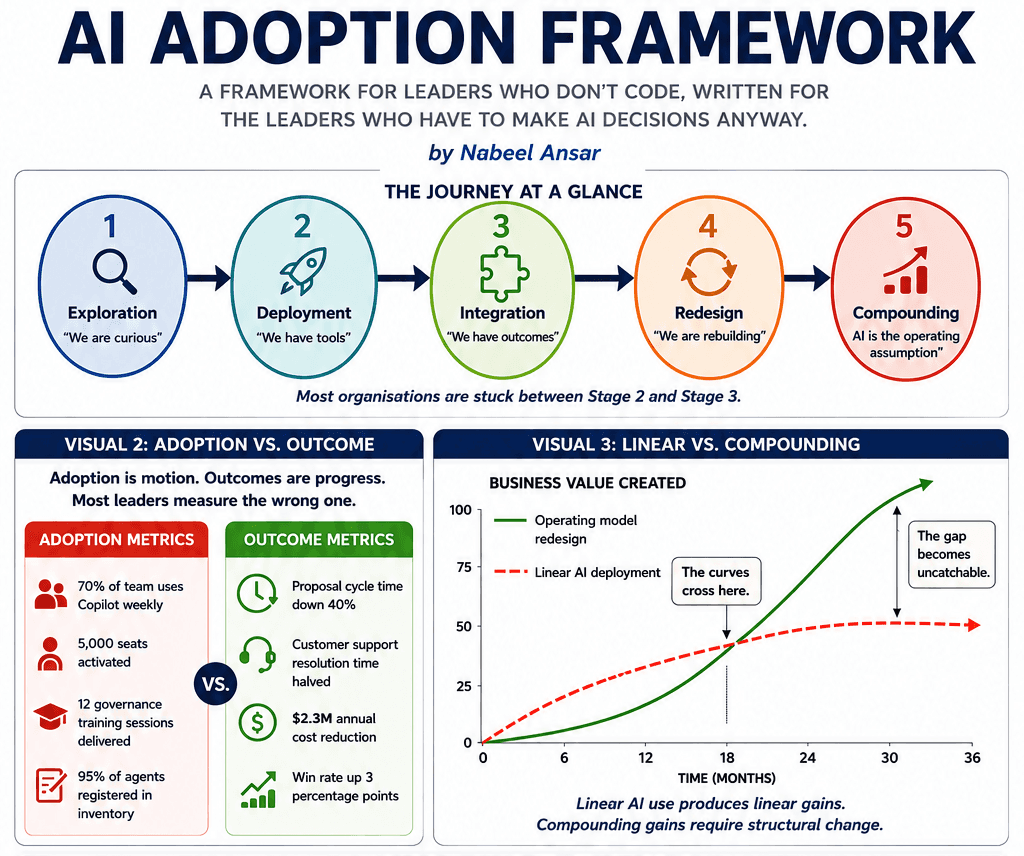
First, run a Copilot usage audit. How many of your users actually use it weekly? Where? For what? If the answer is "very few, mostly for meeting summaries," your problem isn't licensing — it's adoption, and no amount of premium SKU will fix that. Solve adoption before you scale spend.
Second, do the agent inventory. I've written about this before and the importance hasn't changed. Even if you never buy Agent 365, you still need to know what AI agents exist in your environment, what they can access, and who owns each one. The inventory is free. It's the prerequisite for any sensible governance conversation.
Third, ask your team a simple question: if an auditor asked us tomorrow how we govern our AI agents, what would we show them? If the honest answer is "nothing," that's the gap. E7 fills it with Microsoft tooling. You can also fill it with process, policy, and existing tools you already pay for. Either path is defensible. Doing nothing isn't.
The deeper thing
The $99 sticker price will dominate the discourse for the next quarter. Most of that discussion will miss the point.
The real story of E7 isn't whether it's worth $39 more than E5. It's that the largest enterprise software company in the world has decided agent governance is now a first-class category in its commercial lineup. That decision changes the baseline expectation for every business that runs on Microsoft, even the ones that never buy the new SKU.
The leaders who do well over the next 18 months won't be the ones who upgraded fastest. They'll be the ones who used the E7 announcement as a forcing function to ask the questions they'd been avoiding, about adoption, about agent inventory, about governance, and built honest answers before their auditor, their insurer, or their customer asked.
That work doesn't require a license. It just requires deciding to do it.